


From Children’s Ideas to Implementation: How Engaging Educational Content is Born
Teaching Media and Information Literacy (MIL) to youth is a significant challenge. It is often observed that young people find this topic boring or too detached from their daily lives, even though MIL actually covers many themes that are highly relevant to them.
Therefore, the international project YouTHink: Media and Information Literacy for Youth seeks innovative forms and methods to spark interest and involve young personalities in MIL education. Currently, in collaboration with partners from Lithuania, Portugal, Italy, and Slovenia, training content is being developed on various MIL topics: echo chambers, disinformation, deepfakes, virtual friendships, and more. One of the primary goals in creating these materials is to listen to young people, understand their expectations, and adapt the educational content to their worldview.
Creative Freedom at Summer Camp
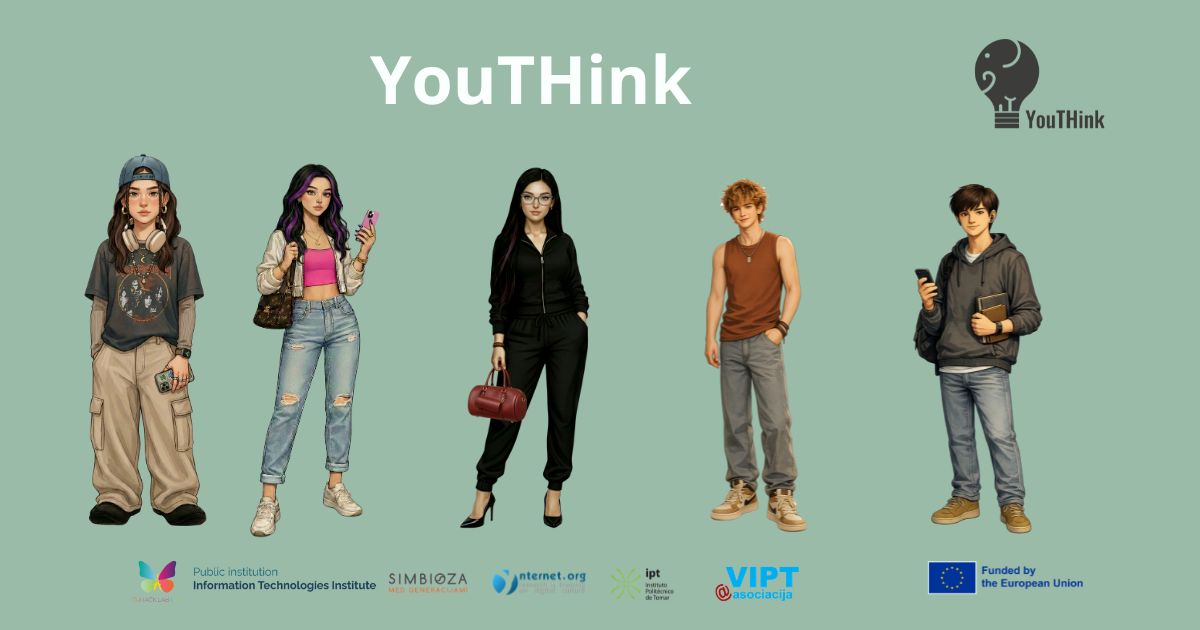
Last summer, during a camp organized by the association Viešieji interneto prieigos taškai (Public Internet Access Points), children were invited to an educational session where they created characters for the YouTHink project’s training materials. There was a strong desire to hear teenagers’ opinions on how they perceive themselves and the environment they live in. Given full creative freedom, the children drew a wide array of characters—from mystical beings reminiscent of anime styles or “furries” to realistic personas—and described their personality traits, hobbies, and more.
From Drawing to Digital Animated Character
The collected works were handed over to the project team, who reviewed the material, selected the most suitable characters, and digitized them.
“At first glance, it might seem like a very easy task—just photograph and transfer the selected drawings to the digital space. However, static images rarely impress today’s youth. Therefore, we decided to animate the characters, give them voices, and depict them in different real-life contexts,” shares Dr. Renata Danielienė, YouTHink Project Manager representing the Information Technology Institute.
To accomplish this, the team utilized Artificial Intelligence tools for image generation and animation. “AI tools like ChatGPT, Gemini, or HeyGen do not always fulfill prompts accurately, so the process of creating characters required not only specific knowledge but also patience,” says Laura Grinečiūtė from the association Viešieji interneto prieigos taškai. According to her, one cannot rely solely on AI algorithms, which inherit human errors and biases from their training data. “Indeed, we tried very hard to ensure our characters resembled real people, with their own strengths and flaws. Fulfilling this task took time,” Laura adds.
Meet the Characters
Four teenagers were created for the project: Kristi, Ema, Lukas, and Adomas. They are all very different, but share one unifying trait—they represent Gen Z and Gen Alpha, whose lives, studies, and entertainment are inseparable from the digital space and social networks like Instagram, TikTok, or YouTube.
These characters are being integrated into every scenario of the MIL curriculum to gamify and diversify the learning process. They invite young people to overcome real-life challenges encountered in digital activities—whether browsing the web, creating content, or playing virtual games.
• Ema (15): Like many her age, Ema is going through a difficult adolescent phase. She is a rebellious personality who finds it hard to fit in and often has different ideas than others. However, on her Instagram and TikTok accounts, she tries to anonymously create an illusion of a “perfect” image to meet beauty and aesthetic standards. She creates a persona because she feels her real self isn’t attractive enough. Her character illustrates the visual and social pressures faced by today’s young girls.
• Kristi (16): Unlike Ema, Kristi is highly self-confident and arrogant. She reflects a common trait in today’s society—consumerism and the display of luxury. She visits beautiful locations just for selfies and buys “knock-off” luxury goods. She often becomes a target for scammers because she tends to impulsively buy products from unreliable ads, frequently falling into the traps of information bubbles and echo chambers.
• Lukas (16): An extremely friendly, open guy who loves communicating and has many friends. He does breakdancing and has a cat at home. On social media, he shares real stories from the dance studio, school, and home. He doesn’t care for filters or polished Reels. He uses AI as a creative tool to help him produce music or visuals for his digital content. Lukas represents youth for whom social media is a digital diary—sharing hobbies and daily life without filters or the need to over-dramatize.
• Adomas (15): A calm, sharp-minded youth with a subtle sense of humor. Adomas never fights for attention or tries to stand out; instead, he feels perfectly comfortable as an observer. While others get involved in unnecessary drama or empty discussions, he analyzes the situation. He can recognize scam schemes, never clicks on suspicious links, and fact-checks information. Adomas understands how bot farms work and how post popularity can be artificially inflated. He illustrates the critically thinking young person who understands both the threats and benefits of digital tools.
Next steps
The MIL training materials are currently under intensive development and are expected to be completed this spring. In the summer and autumn, youth and youth workers will be invited to participate in pilot training sessions to test the new content.