


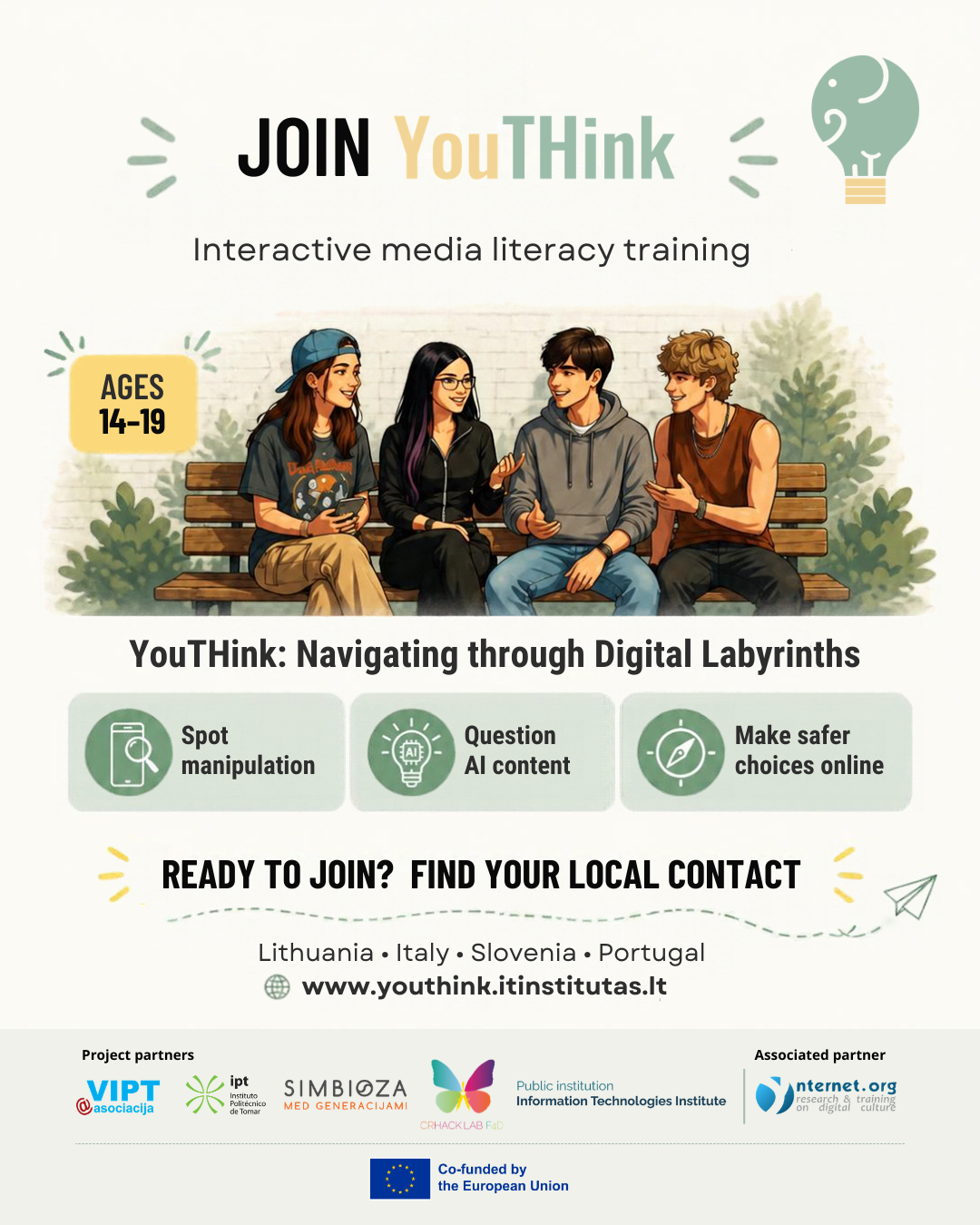
Free pilot training is underway in Lithuania, Italy, Portugal and Slovenia through the international YouTHink project. Young people aged 14–19 are invited to join “YouTHink: Navigating through Digital Labyrinths”, an interactive learning programme that helps them check information, recognise manipulation and use Artificial Intelligence responsibly. Schools, libraries, youth centres and other organisations working with young people are also invited to get involved. The pilot phase is scheduled to run until the end of November 2026.
A perfect photo, a convincing profile or an unexpected message announcing a prize can all prompt a quick decision about what to trust. Generative AI makes it possible to produce realistic images, texts and audio recordings, making appearance alone an unreliable basis for judging authenticity. Young people need opportunities to practise checking where content comes from, examining evidence and considering what its creator wants them to do.
YouTHink addresses these challenges through relatable stories, practical tasks and activities that require participants to make decisions. The pilot phase aims to involve at least 200 young people across the four countries. Participants’ experiences and feedback will help the project team refine the programme.
From consuming information to making informed choices
The programme introduces young people to four characters – Ema, Kristy, Adam and Lukas – who encounter familiar digital challenges, including suspicious offers, social media pressure, AI-generated content, privacy concerns and misleading information.
Participants choose how to respond, receive feedback and reflect on the consequences of their decisions. They may investigate a suspicious scholarship offer, assess the credibility of a social media profile or explore how seemingly perfect online images can influence emotions and choices.
The programme helps participants practise how to:
- Check information sources and assess their reliability;
- Recognise manipulation, misleading messages and signs of online scams;
- Critically evaluate AI-generated content;
- Understand how social media can influence emotions, attention and decisions;
- Protect their privacy and make informed choices about sharing information;
- Create digital content responsibly.
No specialist knowledge of AI, digital literacy is required. Curiosity, questions and a willingness to explore are a good starting point.
AI literacy includes critically evaluating AI outputs
On 18 June 2026, the Organisation for Economic Co-operation and Development (OECD) and the European Commission published Empowering Learners for the Age of AI: An AI Literacy Framework for Primary and Secondary Education. The framework describes AI literacy as knowledge, skills and attitudes that help learners understand how AI systems work, critically evaluate their outputs and use them ethically and creatively. It goes beyond knowing how to write a prompt.
Media and AI literacy are also the focus of a new assessment being developed for PISA 2029. The OECD plans to examine how students evaluate the credibility, quality and purpose of digital content and make informed decisions. The assessment is expected to combine traditional questions with simulated digital environments. Its assessment framework remains under development.
These developments offer a practical perspective on a question facing parents and educators: what skills do young people need in a technology-rich world? Alongside technical knowledge, they need to ask questions, evaluate evidence, understand their own reactions and take responsibility for their digital actions.
Interactive learning shaped by young people’s experiences
YouTHink learning materials are delivered through Moodle and combine interactive tasks, illustrations, short video segments and choice-based activities. These elements help explain situations and give participants opportunities to try out decisions.
Some of the characters originated in drawings created by children during a summer camp. The project team developed and digitised these ideas and incorporated them into the learning scenarios. The characters represent different digital experiences, from the pressure to look perfect or fit in to creative interests and the habit of questioning information.
Technology serves both as a learning tool and as a subject for discussion. Participants explore what AI can help people create, where it can make mistakes and which decisions remain a human responsibility.
Pilot training across four countries
Pilot training is taking place in Lithuania, Italy, Portugal and Slovenia, with youth workers and mentors supporting participants as they explore the activities and discuss their choices.
Schools, libraries, youth centres and youth organisations are invited to help young people access the programme and discuss opportunities for group participation with their local project partner.
The pilot phase will also help the project team understand how the materials work in different learning settings and what support participants need. Young people can share what they find useful, what feels confusing and what could be improved.
How to get involved
Participation in the YouTHink pilot training is free of charge.
Young people aged 14–19, parents and organisations working with young people can contact the partner running the pilot training in their country for information about dates, the learning format, registration and participation arrangements:
- Lithuania: RIAP;
- Italy: CRHACK LAB FOLIGNO 4D;
- Slovenia: Simbioza;
- Portugal: Universidade Politécnica de Tomar (was formerly named the Polytechnic Institute of Tomar).
Participants who need additional support are encouraged to discuss their needs with their local partner.
Project information: youthink.itinstitutas.lt
Learning environment: moodle-youthink.eu
About YouTHink
YouTHink is an Erasmus+ project co-funded by the European Union. It aims to strengthen young people’s media and information literacy and support critical, responsible participation in the digital environment.
Background sources:
- OECD/European Commission (2026). Empowering Learners for the Age of AI: An AI Literacy Framework for Primary and Secondary Education. https://doi.org/10.1787/65cd27d4-en
- OECD. PISA 2029 Media and Artificial Intelligence Literacy. Assessment overview