
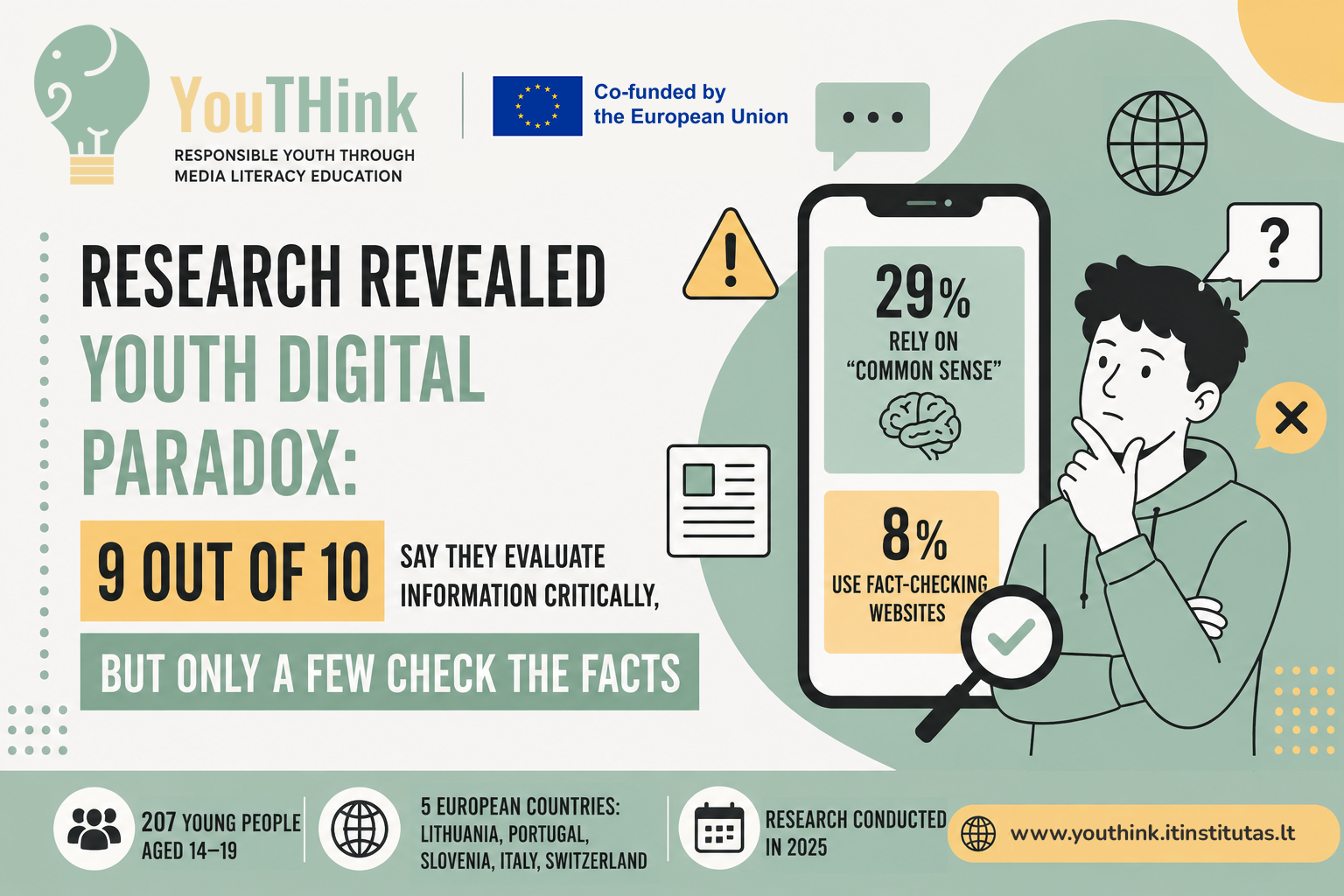
Nine out of ten young people say they critically evaluate information online and do not blindly trust what they see. However, when it comes to checking whether specific information is reliable, a considerable number rely not on fact-checking tools, but on their own intuition.
This gap between confidence in their own critical thinking and actual information-checking habits was revealed by a 2025 survey conducted as part of the international Erasmus+ project “YouTHink”, involving 207 young people aged 14 to 19 in Lithuania, Portugal, Slovenia, Italy and Switzerland.
Critical – but do they verify?
The survey results revealed a contradictory trend. 91% of young people say they do not trust everything they see online, yet 53% admit that they still believe information presented online at least sometimes.
An even clearer gap emerges when looking at how young people check whether information is reliable. 29% of respondents said they rely on their “common sense”, while only 8% use fact-checking websites. Only 7% of respondents ask their parents for their opinion on whether information is reliable.
Parents also play only a limited role in this information-checking process – just 7% of young people ask them for their opinion on whether information is reliable.
The greatest challenge – knowing what can be trusted
The biggest challenge begins when young people need to decide which information is trustworthy. As many as 41% of respondents identified determining whether a source of information is reliable as one of their greatest difficulties. A further 28% find it difficult to distinguish fact from opinion.
This is particularly important in an environment where young people encounter not only traditional news, but also social media content, advertising, opinions, AI-generated texts and images, as well as disinformation. Media literacy, tackling disinformation and artificial intelligence are among the main topics addressed by “YouTHink”.
Knowing how to use a phone does not mean knowing how to evaluate information
Discussions with media literacy experts held during the “YouTHink” project revealed a similar problem – young people may feel confident using a phone, TikTok or creating content, but they face difficulties when they need to carry out more complex tasks: determine whether a news item is reliable, check sources, identify the author of content or understand who funds a particular information channel.
That is why it is not enough to keep telling young people, “don’t believe everything you see online”. Practical skills are needed: how to check a source, distinguish fact from opinion, find the original source of information and recognise manipulation.
Young people say it themselves: less theory, more practice
The survey revealed not only gaps in the critical evaluation of information, but also how young people themselves would like to learn.
When asked which learning format they would find most appealing, the largest share of respondents chose interactive games and quizzes – 24%. Practical tasks were chosen by 19%, the use of technology by 15%, and the same proportion selected educational videos. A further 13% would like to learn by analysing interesting examples and situations from young people’s lives.
Youth workers and experts from other fields who took part in “YouTHink” creative workshops reached a similar conclusion: to reach a young person, it is not enough simply to provide information about media literacy. Learning must be engaging, practical and linked to situations that young people genuinely experience in the digital environment.
For this reason, when developing the “YouTHink” learning programme, considerable attention is given to real-life digital situations: how to respond to a suspicious message, assess a social media post, recognise an AI-generated fake or make a decision when faced with a dilemma involving an online friendship. The programme includes tasks involving information analysis, fact-checking, simulations, discussions and content creation.
These are the principles underpinning the international “YouTHink” project. It is developing a media literacy learning programme for young people aged 14–19 and an interactive virtual platform combining real-life digital situations, visual content, gamified elements, digital technologies and practical tasks. The aim of the project is to help young people not only learn more about disinformation or artificial intelligence, but also develop the ability to critically evaluate what they see on their screens every day.
About the project
“YouTHink – Responsible Youth through Media Literacy Education” is an Erasmus+ KA220-YOU Cooperation Partnership project running from November 2024 to December 2026. The project is implemented by five organisations from Lithuania, Portugal, Slovenia and Italy. Its aim is to strengthen the media literacy of young people aged 14–19 and their ability to critically evaluate information encountered in today’s digital environment through innovative learning methods, digital technologies and gamified elements.
More about the project: www.youthink.itinstitutas.lt
Views and opinions expressed are however those of the author(s) only and do not necessarily reflect those of the European Union or the Youth Affairs Agency. Neither the European Union nor the granting authority can be held responsible for them.