
Is writing a single prompt enough for generative artificial intelligence to create the character you want? When developing the characters for the international Erasmus+ project “YouTHink”, one prompt was not enough. Turning teenagers’ drawings into consistent digital characters that remain recognisable across different learning situations and can speak multiple languages required not only generative AI tools, but also human creative decisions, evaluation and continuous refinement of the results.
Ema, Kristy, Lukas and Adam were created as characters for a media literacy learning programme aimed at young people aged 14–19. The teenagers’ own ideas and drawings were used as part of the visual basis for the characters, but transferring them into the digital environment presented another challenge – how to use generative artificial intelligence in a way that would allow the characters to retain their personalities and appearance and be used consistently across different learning scenarios.
AI Helped with the Creative Process, but People Made the Decisions
Before generating the final character images, characters commonly seen on popular social media platforms were analysed and different character archetypes were developed. Gemini was also used at this stage, helping to further develop the archetypes based on the topics and theoretical framework addressed in the project.
When formulating prompts, the aim was to maintain a connection with the teenagers’ drawings and the social media characters that had been analysed, to create age-appropriate and youth-friendly character portrayals, and to ensure that their appearance reflected the intended archetypes. As far as possible, recognisable brands were also avoided. Based on these prompts, initial character illustrations were created using ChatGPT and then shared with the project partners.
However, even with a detailed description of the desired outcome, the first generated versions of the characters differed considerably from their final appearance. Different generation approaches were therefore tested, the results were shared with the project partners, their feedback was collected, and the characters were gradually refined accordingly.
“Using generative AI in a creative process is not a matter of writing a single prompt and immediately getting the final result. You need to know clearly what you are trying to achieve, evaluate what the system generates, identify inconsistencies and continuously refine the task. When creating the ‘YouTHink’ characters, we repeated this process many times – their final appearance is not simply an AI-generated result, but also the outcome of our team’s decisions, experimentation and feedback from the project partners,” says Renata Danielienė, “YouTHink” Project Coordinator.
How Do You Keep the Same Character Consistent Across Different Stories?
“One of the more challenging tasks was ensuring that the same character remained recognisable in different situations. With generative AI, it is not enough simply to say that you want the same character – you need to describe their appearance, style and other consistent features very precisely. We therefore developed a common prompt structure that can be adapted to different scenes while maintaining the characters’ visual consistency,” says Paulius Danielius, who worked on the development of the “YouTHink” digital characters.
This is particularly important because Ema, Kristy Lukas and Adam appear in different learning scenarios and need to remain easily recognisable even when the setting or situation changes.
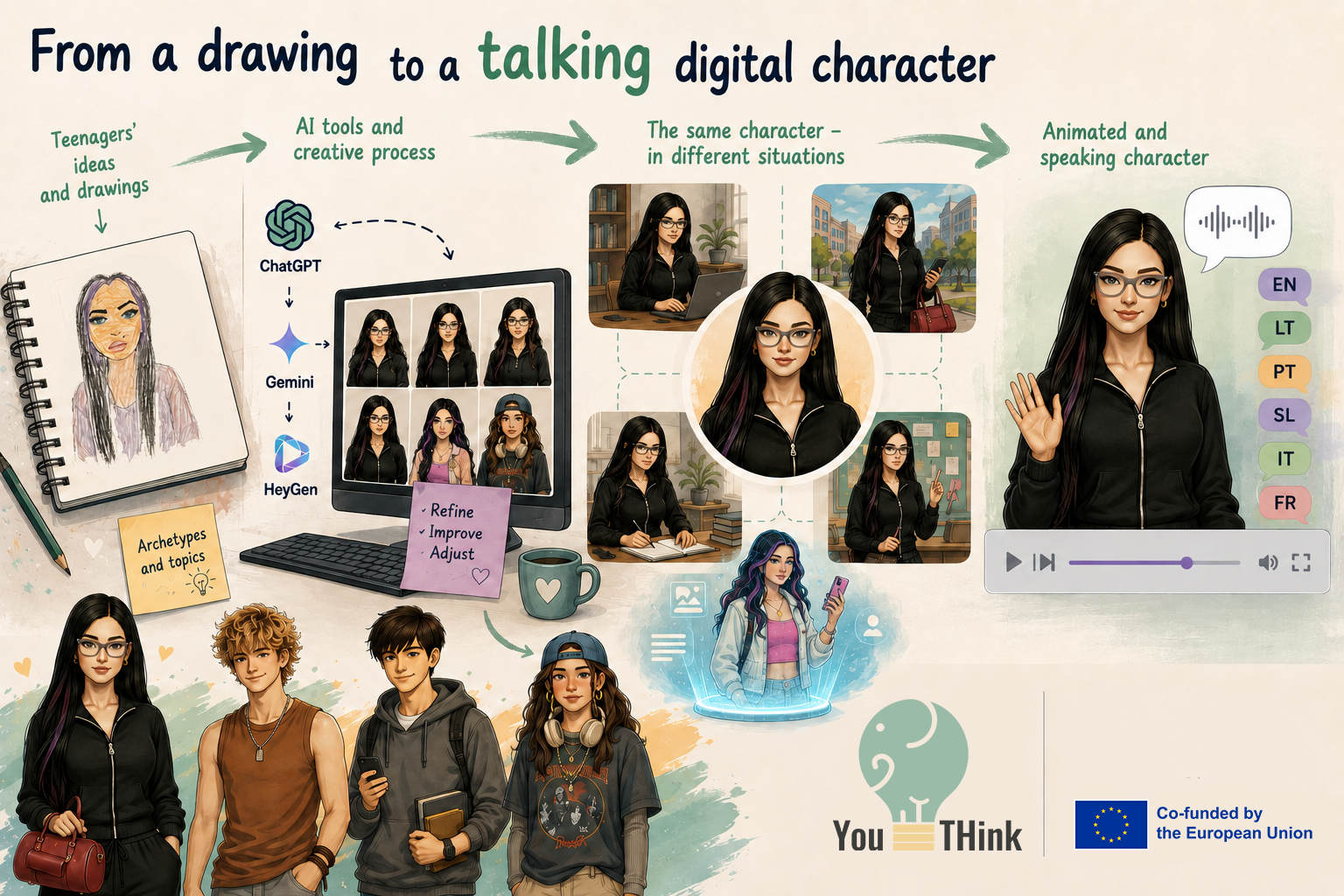
Illustration created using ChatGPT.
When the Characters Found Their Voices
The next stage was to give the digital characters a voice. Using HeyGen, Ema, Kristy, Lukas and Adam were animated and initially spoke in English. After testing this possibility, another idea emerged – to take it one step further and have the characters speak in the national languages of the project partners as well. The same HeyGen environment could be used for this purpose.
This stage also became a shared learning process for the partners. The project teams learned together how to use the platform’s features and, during meetings, shared newly discovered possibilities, practical solutions and useful tricks for achieving better results.
However, getting a character to speak another language turned out not to be the same as simply translating their text. Automatically generated pronunciation did not always sound natural, so in some cases it was necessary to look for synonyms or rephrase sentences – preserving the same meaning while achieving a more natural sound.
This experience showed that adapting multilingual digital content is not simply a matter of translation. It is also important to consider how the technology interprets and pronounces the text, while the final result still needs to be listened to and evaluated by a person.
The “YouTHink” characters and how they found their voices can be seen in the project video:
Meet the “YouTHink” Characters
AI Is Only One of the “YouTHink” Learning Topics
Although considerable attention was given to generative artificial intelligence when creating the “YouTHink” characters, the learning programme itself is much broader. Young people explore issues related to information reliability, disinformation, social media, online safety, privacy, digital well-being and other aspects of contemporary digital life. Artificial intelligence is one of these topics and, at the same time, one of the tools used to create the learning materials.
The process of creating the “YouTHink” characters also became a practical example of what the project aims to teach young people – to use technology not passively, but consciously and critically. In this case, generative AI provided an opportunity to experience its capabilities and limitations in practice and to see why it is important to critically evaluate the results produced by technology.
The character videos will be publicly available on the project’s YouTube channel.
About the Project
“YouTHink – Responsible Youth through Media Literacy Education” is an Erasmus+ KA220-YOU Cooperation Partnership project running from November 2024 to December 2026. The project is implemented by five partner organisations from Lithuania, Portugal, Slovenia and Italy, with the associated partner Ynternet.org from Switzerland also participating in project activities. The project aims to develop media literacy among young people aged 14–19 and strengthen their ability to critically evaluate information encountered in today’s digital environment through innovative learning methods, digital technologies and game-based elements.
More about the project: www.youthink.itinstitutas.lt
Views and opinions expressed are however those of the author(s) only and do not necessarily reflect those of the European Union or the Youth Affairs Agency. Neither the European Union nor the granting authority can be held responsible for them.