
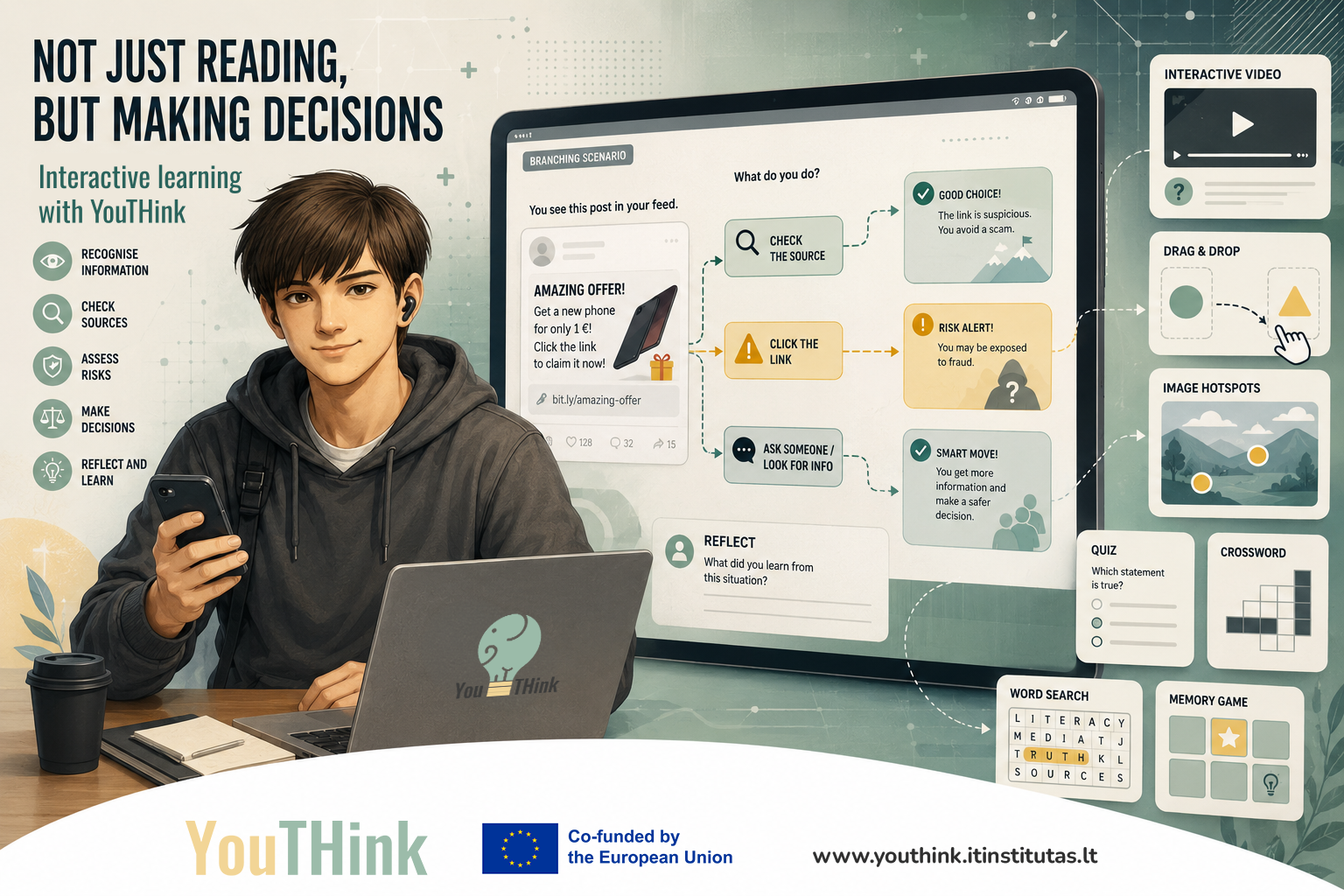
Knowing how to behave in the digital environment is one thing. Facing a situation yourself, where you need to assess information, recognise a risk and decide how to act, is quite another. This is precisely the kind of learning experience that the international Erasmus+ project YouTHink aims to create in its virtual learning environment.
Designed for young people aged 14–19, the YouTHink programme comprises 17 learning scenarios. When developing the digital learning materials for these scenarios, the aim was to ensure that they did not become just another collection of texts and videos. One of the key tasks was therefore to select appropriate forms of interactivity for different learning situations.
For this purpose, H5P was chosen – a technology that allows digital learning content to be enhanced with interactive tasks, videos, game-based elements and decision-making scenarios. More than 20 different types of H5P activities have been used in the YouTHink project, selected according to the needs of the specific content and learning task.
Illustration created using ChatGPT.
The Decision Began with an Analysis of Tools
Before selecting the technology, various paid and free tools for creating interactive content were evaluated, taking into account their cost, ease of use, interactive capabilities, integration with Moodle, localisation, compatibility with mobile devices and functionality suited to the project’s needs.
The selected H5P technology made it possible to create different types of interactive activities within a single Moodle learning environment and to link the results of assessed activities to Moodle’s assessment system. Equally important was the ability to continue using the content after the project ends. H5P does not require an additional commercial content-authoring licence, meaning that the materials can continue to be edited, updated and further developed. This was an important difference compared with some of the alternatives analysed, which require paid licences for full functionality or content export capabilities.
The decision to use H5P was also reinforced by the previous experience of YouTHink project coordinator Renata Danielienė. Although, when delivering training to university staff on the possibilities offered by Moodle, she had long regarded H5P primarily as an additional element for interactive content, even before the YouTHink project, a training course on the possibilities of virtual learning environments inspired her to test the technology on a considerably more complex task. She enhanced a university course on cyber risk and incident management with five scenarios, each containing between 50 and 80 possible answer options. This format proved effective not only for teaching students to analyse situations and make decisions, but also for assessing their knowledge.
“Until then, H5P had been just one of many Moodle possibilities for me – useful, but mainly as a way of supplementing content. After working with complex scenarios, I began to see it differently. I realised that interactivity does not have to be an add-on to learning materials; it can be a way of constructing the learning situation itself: the student has to make a decision, and that choice determines what happens next. When we started looking for a solution for interactive content in the YouTHink project, I remembered this experience. I was able to offer the partners not a theoretical idea, but a principle that had already been tested in practice,” says YouTHink project coordinator Renata Danielienė.
Not Every Click Means the Same Kind of Interactivity
One of the advantages of H5P is the ability to choose from a wide range of interactive content types. In the YouTHink project, these were selected according to the content and learning objective of each specific scenario.
For example, “Branching Scenario” makes it possible to create interactive simulations of situations in which the learner’s choice determines how the story develops, while “Interactive Video” allows questions and other interactive tasks to be embedded in a video. “Interactive Book” makes it possible to combine text, video and other learning materials with interactive activities within a single structure, while “Image Hotspots” enables learners to actively explore visual information. Question sets, multiple-choice, true-or-false, word-marking and drag-and-drop activities allow learners to check their understanding, while crosswords, word searches and memory games provide opportunities to revisit content through game-based activities.
Interactivity in the YouTHink environment is therefore not simply an extra button or a click on the screen. Different activities allow learners not only to engage with information, but also to evaluate and verify it, make a decision, see its consequences and reflect on their choice.
A Wide Range of Choices Also Became a Challenge
However, what initially appeared to be one of H5P’s greatest advantages – the wide variety of interactive elements – also proved challenging in practice. Different H5P types have different authoring logic and interfaces, and creating more complex scenarios and simulation-based activities required more than simply becoming familiar with the tool’s basic functions.
The use of H5P therefore also became a shared learning process for the international project team. Partners were introduced to the possibilities for creating different elements and shown working examples, while during project meetings the teams shared their experiences, solutions they had discovered and challenges they had encountered.
In this way, the partner team gradually built practical experience in selecting and applying different H5P types to specific media literacy learning objectives.
Sharing the Project’s Experience with the Wider Education Community
The experience accumulated by the YouTHink team did not remain within the project. In May 2026, it was presented during training organised by the Lithuanian Distance and E-Learning (LieDM) Association for staff from Lithuanian educational institutions.
Renata Danielienė, who delivered the training, demonstrated the YouTHink Moodle learning environment and its working H5P examples live to participants, presenting interactive content development solutions tested during the project. More than 500 participants registered for the training.
“What I find most interesting about this story is how the journey of knowledge evolved: an idea gained during training became my own experiment at the university, later a solution that I shared with the international project partners, and then the experience we all accumulated within the project, together with working examples, returned to a much wider education community. For me, this is what meaningful sharing of good practice is about – passing on not only what worked, but also what we had to learn along the way,” says R. Danielienė.
In this way, the experience accumulated within the YouTHink project extends beyond the project itself – the solutions developed can continue to be used and improved, while the knowledge gained in creating them is also shared with other educational organisations and professionals.
About the Project
“YouTHink – Responsible Youth through Media Literacy Education” is an Erasmus+ KA220-YOU Cooperation Partnership project running from November 2024 to December 2026. The project is implemented by five partner organisations from Lithuania, Portugal, Slovenia and Italy, with the associated partner Ynternet.org from Switzerland also participating in project activities. The project aims to develop the media literacy of young people aged 14–19 and their ability to critically evaluate information encountered in today’s digital environment by using innovative learning methods, digital technologies and game-based elements.
More information about the project: www.youthink.itinstitutas.lt
Views and opinions expressed are however those of the author(s) only and do not necessarily reflect those of the European Union or the Youth Affairs Agency. Neither the European Union nor the granting authority can be held responsible for them.